

01 — What Made Im'peccable Chicken Unique?
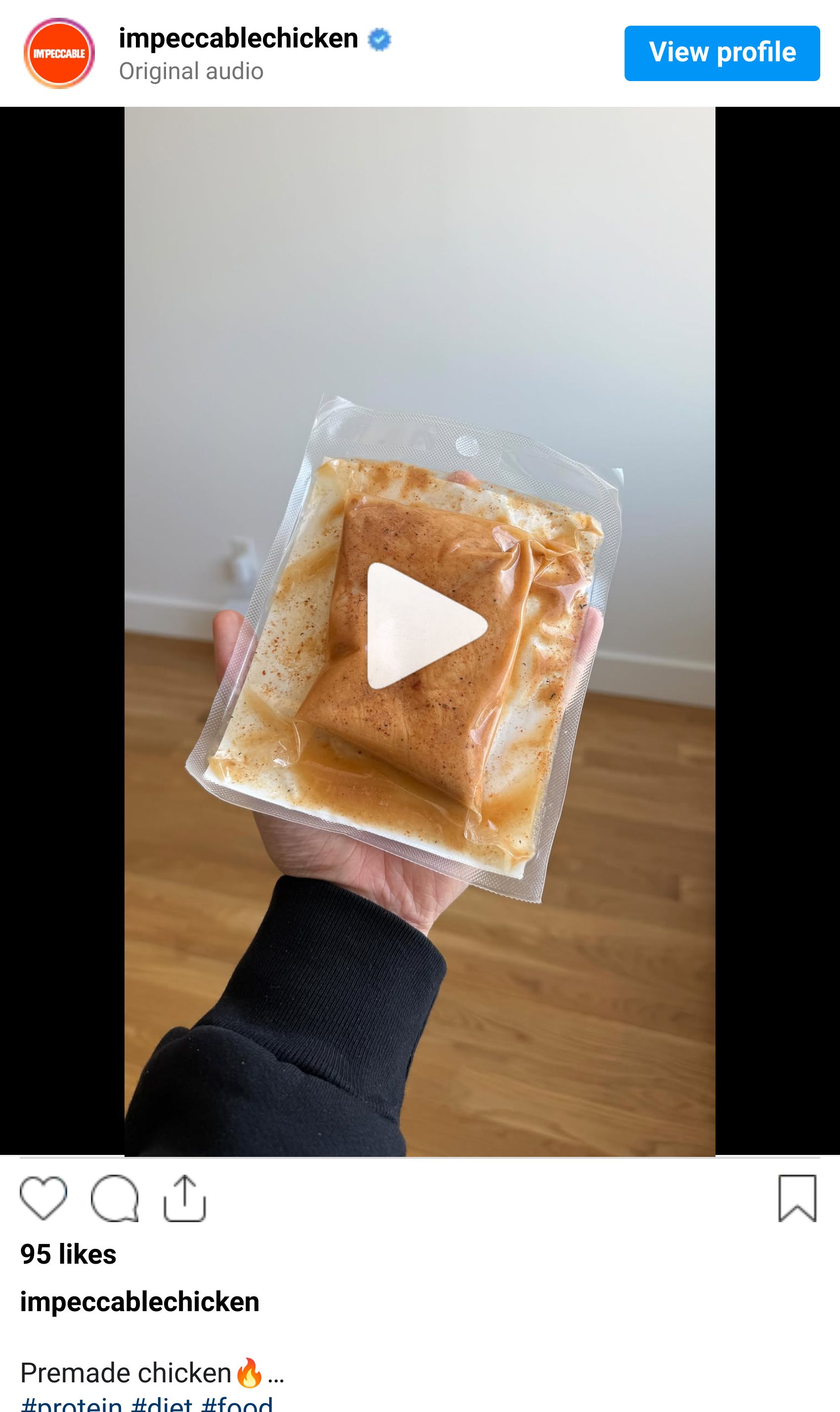
Im'peccable Chicken is not another protein bar. It is not a meal-prep service. It is not a supplement. It is one of the most deceptively simple product concepts in the modern CPG market: a single vacuum-sealed pouch of fully cooked, seasoned chicken breast — portable, preservative-free, and ready to eat in 30 seconds. And yet, as simple as that sounds, nothing like it existed at scale in the United States when founder Melina Chang launched it in 2023.
A Category That Didn't Exist Yet
Chang first encountered this product format in Taiwan, where ready-to-eat chicken breast pouches are sold in nearly every 7-Eleven and Family Mart across the country. Co-founder Riley Yen made the same discovery during a solo cycling trip around Taiwan, where he saw them on shelves in convenience stores from Taipei to Kaohsiung. Back in the U.S., that shelf space was dominated by protein bars filled with sugar, artificial flavors, and a long list of additives. The insight was obvious once you saw it: why was real food protein so much harder to find on-the-go than engineered powder bars?

The Product Itself Was the Differentiator
What set Im'peccable apart technically came down to three things:
Sous vide cooking — each chicken breast is cooked using the classic French low-and-slow method that locks in moisture, giving it a texture that shelf-stable chicken rarely achieves.
Minimal ingredients — no preservatives, no added sugars, no artificial flavors. The Original Pepper variant is gluten-free, keto-friendly, and paleo-friendly.
Cold-chain direct shipping — orders ship refrigerated below 40°F, and unopened pouches stay fresh for 30 days in the fridge or 12 months in the freezer, without requiring shelf-stabilizing chemicals.
A Founder Story That Was the Brand
Perhaps the most powerful differentiator wasn't the product — it was Melina Chang herself. During the COVID-19 pandemic, Chang's weight climbed to 240 lbs. She began using the ready-to-eat chicken breast she found in Taiwan as a cornerstone of her daily diet and dropped over 130 lbs in 8 months. She then discovered the product didn't exist in the U.S. and decided to build it herself.
At 21 years old, she dropped out of business school, secured a $350,000 loan from her parents (who are in the food distribution industry), assembled an R&D team, and built a USDA-inspected production facility from scratch in Commerce, California. Every pouch is tested at ISO-certified labs for pathogens including Listeria and Salmonella — standards that go beyond the daily USDA inspection already in place.
The production cost per unit is $1.70. The average selling price is $5.40 — a healthy margin that reflects both quality positioning and direct-to-consumer pricing power.

02 — Their Detailed Marketing Strategy
Im'peccable Chicken's marketing strategy is a masterclass in lean, authentic brand-building — executed almost entirely without a traditional agency budget. The team did their own photoshoots, ran their own email campaigns, drove forklifts, and hand-delivered over 30 early orders. Here's how each pillar of the strategy worked.
2.1 — Founder-Led Storytelling
The anchor of Im'peccable's marketing was Melina Chang's personal transformation story. Losing 130 pounds using a product she then built herself is the kind of authentic narrative that no advertising agency can manufacture. The brand leaned into this completely.
Chang shared her story publicly — including on Shark Tank Season 17, Episode 2, where she revealed her weight struggle to an audience of millions. A LinkedIn post she wrote — "I shared my biggest insecurity with 5 million people on Shark Tank" — became organic content that drove both brand awareness and deep emotional connection with potential customers.
This approach works because it collapses the distance between founder and customer. The person who made the product is the product's most compelling proof point.

2.2 — Lean Influencer Marketing With Outsized ROI
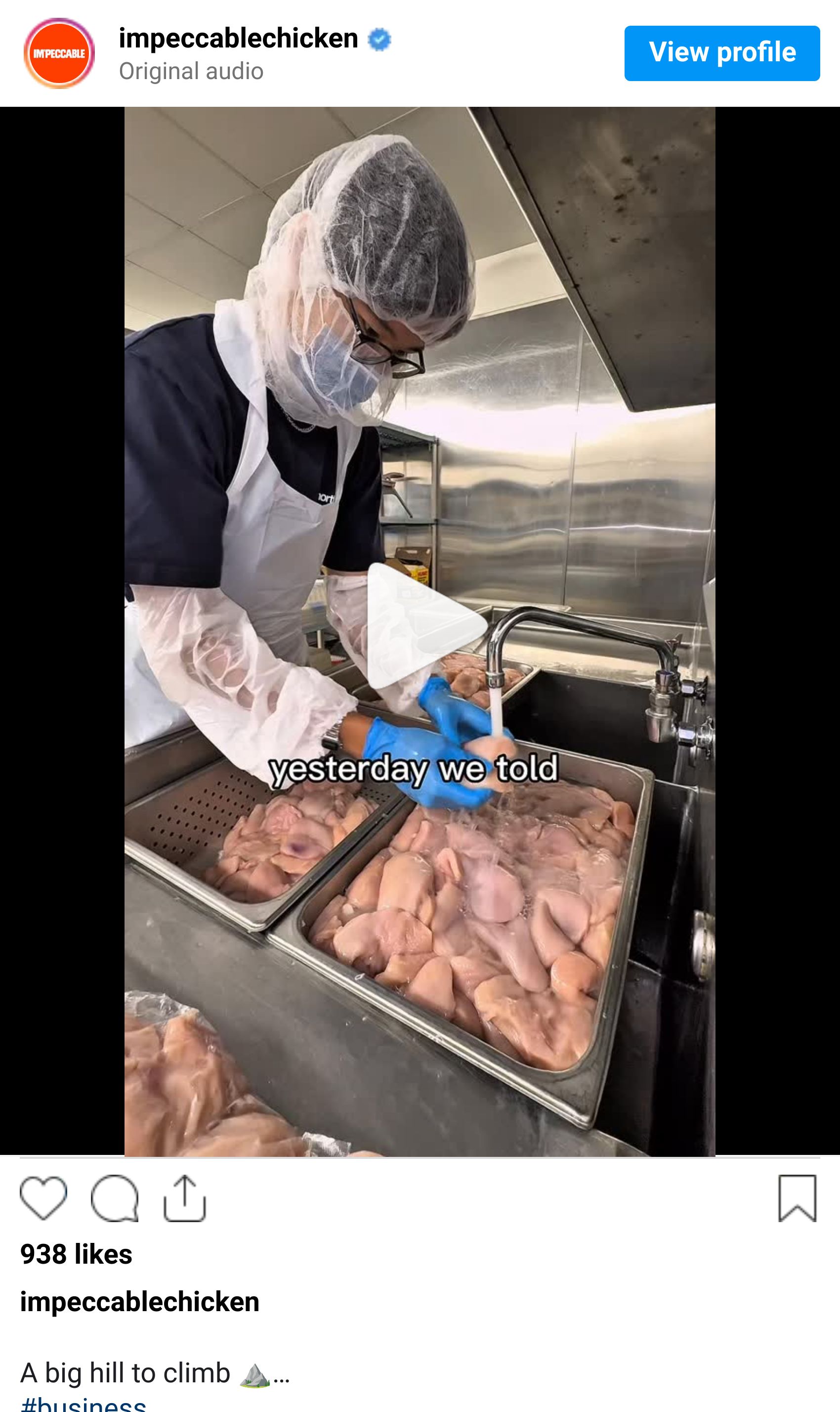
Before the Shark Tank appearance, Im'peccable ran a single influencer partnership at a cost of $2,000 — and generated 2 million views. That works out to a $0.001 cost-per-view, a number that most brands with professional marketing departments would struggle to match.
The approach was simple: find creators in the fitness, health, and nutrition space whose audiences already care about protein and clean eating. Give them the product. Let them show real reactions. No over-produced scripts, no brand-speak.

The effectiveness came not just from the spend but from the fit between the product and the audience. Fitness and high-protein lifestyle creators aren't just followers of a trend — they are the exact customer the product was built for.
2.3 — Grassroots & Campus-to-Market Growth
Im'peccable Chicken didn't launch with a national retail deal. It launched in a dorm room. Chang began experimenting with sous vide chicken at USC in 2023 and started selling to fellow students at Trojan Marketplace and along Trousdale Parkway on campus.
This campus-first strategy did several things simultaneously:
Created a real feedback loop — students tasted the product and gave immediate, unfiltered reactions.
Built a community of early believers who became organic brand ambassadors.
Generated proof points (real customers, real repeat purchases) that could later be presented to investors and retail buyers.
One USC student, after trying it at a campus pop-up, bought a 20-pack online the same day. That buying behavior — trial to online conversion — is exactly the funnel the brand needed to prove out before scaling.
2.4 — Shark Tank as a Marketing Channel
The team made a deliberate strategic choice: rather than over-investing in paid marketing to break into retail, they chose to build brand equity through high-visibility platforms. Shark Tank was the most important of these.
Co-founder Nick Hsu explained the thinking directly: rather than spending heavily trying to break into a market that wasn't ready for them, they built brand equity through high-visibility opportunities like Shark Tank.
The pitch was structured masterfully — opening with Chang's weight-loss story for emotional hook, pivoting to the product's clinical simplicity (27g protein, 140 calories, zero additives), and landing on the market opportunity. All five Sharks made offers — an extremely rare event on the show. The team accepted a $200,000 deal for 15% equity from Kevin O'Leary and Lori Greiner.

2.5 — Direct-to-Consumer Model & Retail Ambitions
Im'peccable Chicken sells exclusively direct-to-consumer through its website and Instagram. This is both a constraint and a strength — full margin capture, a direct customer relationship, and real-time feedback on every order.
The company had already attracted interest from major retail buyers at Sprouts, Whole Foods, Bristol Farms, Target, H-Mart, 7-Eleven, and 99 Ranch Market before their Shark Tank appearance — but was constrained by production capacity rather than demand. The $200K Shark Tank deal is explicitly intended to unlock manufacturing scale and push into convenience stores, gyms, cafes, and airports.

03 — How Other Business Owners Can Use This
Impeccable Chicken's story contains several highly transferable lessons for any founder building a physical product or consumer brand. These are specific, replicable moves — not vague principles.
3.1 — Find the White Space by Looking Abroad
Both Chang and Yen discovered the product concept in Taiwan, where it was already a mature, proven market. The insight was: if it works there, why doesn't it exist here?
For any business owner, this is a powerful research framework. Markets outside the U.S. — particularly in Asia, Europe, and Latin America — often have products, formats, or behaviors that haven't yet crossed over. Looking internationally for white space in your own category is an underused competitive intelligence move.
The question to ask yourself: What do consumers in another country do naturally that people in my market don't have easy access to?
3.2 — Your Personal Story Is a Marketing Asset, Not a Liability
Many founders hide the messy, vulnerable parts of their story because they fear it will undermine their professional credibility. Chang did the opposite — and it became the brand's most powerful marketing asset.
She shared a story about reaching 240 lbs, struggling mentally during COVID, and transforming her life through the product she later built. That story is not just authentic; it is the emotional proof that the product works. She is the customer.
If you built your product because you personally needed it, that story is your most valuable marketing channel. The rule: be the customer your brand is trying to reach, and say so publicly.
3.3 — Validate on Campus or in Community Before You Scale
Impeccable didn't launch into Whole Foods. It launched on Trousdale Parkway at USC. Starting in a contained, high-density community gave the team fast and honest feedback on flavor, texture, and packaging, a repeatable buyer pool, and social proof in the form of real customers before any investor conversation.
Any consumer product brand can use this strategy — whether it's a farmers market, a gym, a neighborhood, a LinkedIn community, or a local event. The goal is to find a small, high-density group of your ideal customer and let them fall in love with the product before you spend on distribution.
3.4 — Use High-Visibility Platforms Instead of Paid Ads
Im'peccable made a deliberate choice to avoid heavy paid marketing spend and instead invest in brand equity through platforms like Shark Tank and targeted influencer partnerships. The ROI on their $2,000 influencer campaign (2 million views) far exceeded what the same budget would have generated in Meta or Google ads — especially for a new, unknown brand.
The practical version of this for other brands: identify where your ideal customer goes to discover new things — whether that's a specific podcast, a niche YouTube channel, a subreddit, or a local event — and prioritize presence there over broad paid distribution. High-fit, low-spend beats low-fit, high-spend every time in the early stages of a brand.
3.5 — Build the Manufacturing Moat Early
One thing Im'peccable's story reveals is how a production constraint almost became a ceiling — retailers wanted to launch them nationally, but they couldn't meet the volume. The $200K Shark Tank investment was needed specifically to solve this.
For product businesses: if you have demand, solve supply before you solve marketing. A waitlist is a marketing asset. Being unable to fulfill orders from Whole Foods is a missed generational opportunity.
Chang built her own USDA-inspected facility rather than outsourcing production. That vertical integration gave her quality control, better margins, and direct ownership of the food safety story — all of which became marketing messages in their own right.
04 — Key Takeaways
Im'peccable Chicken is still a very young brand, but the combination of product clarity, founder authenticity, and strategic marketing efficiency makes it one of the most instructive startup stories in the modern CPG space.
For Product Builders
Solve a real problem you personally experienced. The most credible products are built by people who needed them.
Simplicity is a feature. 27g protein, 140 calories, zero additives — that's a message that travels without explanation.
Own your production. Vertical integration is a marketing advantage, not just an operational one.
For Marketers
$2,000 plus the right influencer beat $200,000 spread thin. Fit matters more than budget.
Founder stories are your most differentiated content. No competitor can copy your personal truth.
Use high-visibility earned media — TV, press, podcasts — as your paid media substitute in the early stage.
For Business Strategists
Look internationally to find your domestic white space. Taiwan's convenience store shelves inspired a U.S. category.
Prove demand at micro-scale before investing in macro distribution. A dorm room to $85K in 7 months is proof enough for Shark Tank.
Retail interest without production capacity is a trap. Solve supply before you negotiate distribution.

